Boredom or a blank sketchbook page
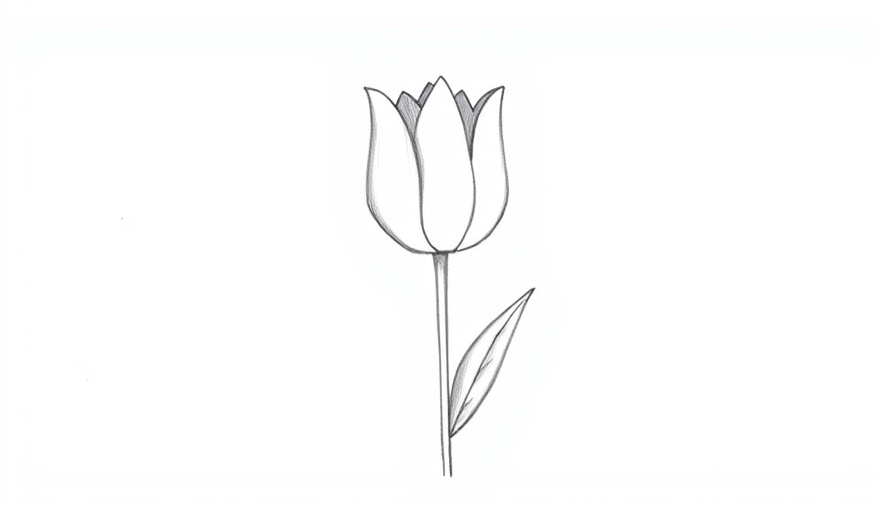
A blank page and ten spare minutes is the most common reason anyone searches for something to draw. The fix is mechanical, not creative: stop trying to invent a subject from nothing and instead pull one from a list built for exactly this moment.
Lists built for artist's block, like the one Rapid Fire Art put together, work because they remove the decision entirely — you don't choose a subject, you pick a number, or close your eyes and land on one. The same logic runs through longer collections such as thevirtualinstructor's 101 sketchbook ideas, which groups objects, animals, and scenes so a bored reader can scan a category instead of staring at a blank list. The value of either isn't the specific nouns on the page; it's that scanning replaces deciding, and deciding is the part that stalls a bored reader.
What none of these lists tell you is which entries are actually quick. A flower, a doodle, and a cartoon face are not the same time commitment, even though they're often stacked in the same fifteen-item block. A rough way to sort a prompt before you commit to it:
| Property | Fast subject | Slow subject |
|---|---|---|
| Outline shape | Closed, simple curve (circle, teardrop, oval) | Open, branching, or made of many small parts |
| Symmetry | Left and right halves roughly match | Asymmetrical, needs constant comparison |
| Proportion tolerance | Forgiving — slightly-off still reads correctly | Strict — small errors are obvious (faces, hands) |
| Stroke count | Under twenty marks | Dozens of marks, overlapping |
| Typical time | A few minutes | Fifteen minutes or more |
Mindful Art Studio's collection of ideas doable in five minutes is one of the few sources that ties a subject to an actual time box rather than just calling it "easy," which is the more useful promise when the real trigger is boredom rather than a lesson plan. Knowing a prompt fits inside five minutes is what actually lets a reader commit to it instead of scrolling past for something that looks less risky.
Once you've picked a prompt, the sequence is short:
- Open the list, or pick a category (flowers, doodles, faces, animals).
- Choose one entry — by scanning, not deliberating.
- Set a rough time limit (five minutes is a reasonable default for a first attempt).
- Draw it once, without erasing mid-way.
- If it worked, pick the next one; if it didn't, note why before moving on.
That last step is the one bored-browsing skips, and it's the difference between filling a page and getting anything out of it. A page of ten unfinished attempts teaches less than three finished ones, however rough, because a finished attempt is the only kind you can actually compare against the next.
Beginner believes they have 'no skills'
A subject looks impossible mainly because it's being looked at as one shape instead of several. Every recognisable drawing — a flower, a hand, a face — is a small number of basic forms (circles, ovals, rectangles) placed in relation to each other, then refined with contour and detail on top.
Adobe's rundown of easy things to draw for beginners is useful less for its subject list than for how it frames the approach: start from geometry, not from the finished image. A tulip is a lopsided oval on a straight stem. A cartoon cat's head is a circle with two triangles. Skill, in this framing, isn't a fixed trait you either have or lack — it's whether you break the subject down before you try to render it.
The order that keeps a beginner drawing from collapsing into a mess is:
- Block in the basic shapes lightly, without pressing hard — a 2B or HB pencil on ordinary cartridge paper is enough; nothing about this stage needs specialist material.
- Check proportions against each other (is the head shape wider than the stem is long?) before adding a single detail.
- Add contour lines that follow the block-in shapes rather than replacing them.
- Layer in detail — petals, fingers, features — only once the underlying shapes are confirmed.
- Darken the final lines and erase the guide shapes last, not first.
Where beginners actually go wrong is rarely the drawing itself — it's one of three habits: pressing too hard on the first pass so mistakes can't be corrected, drawing the outline before checking proportion, or fixating on one detail (an eye, a fingernail) before the whole shape is blocked in. All three are fixed by slowing the block-in stage down, not by "practising more" in the abstract. A circle drawn too dark on the first attempt can't be nudged half a centimetre without a visible ghost line, which is why the lightest pass should always come first regardless of subject.
Digital drawing changes almost none of this — a stylus on a tablet still benefits from a light block-in layer you can adjust before committing to line work; the only real difference is that undo replaces the eraser, and a lower-opacity sketch layer replaces the light pencil pass. The sequence of shapes-before-detail holds either way, because the problem it solves — committing to a line before you've checked it against the rest of the drawing — has nothing to do with the tool.
Reader wants to improve, not just pass time
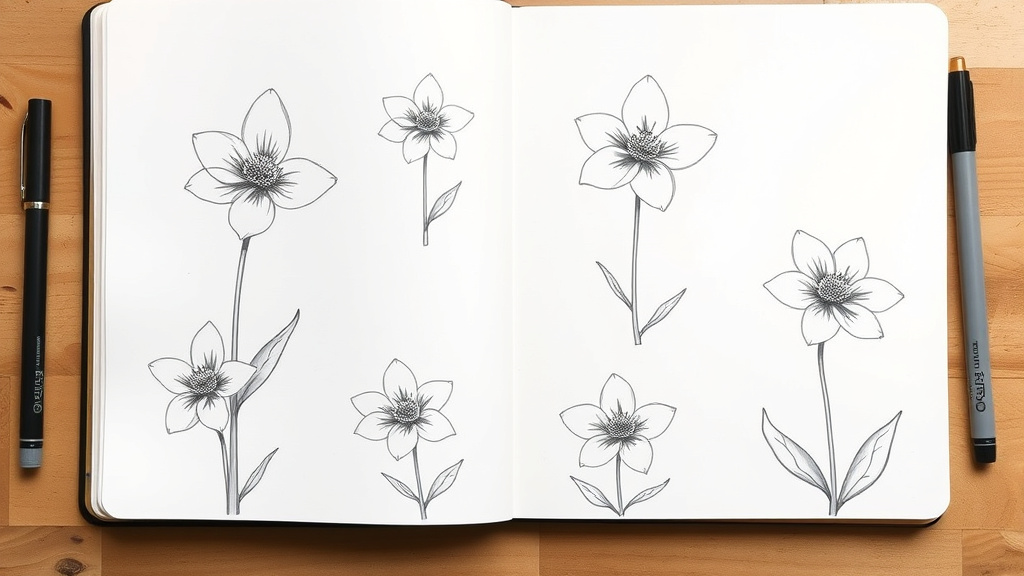
The same easy subjects are worth drawing more than once because repetition is where the actual skill-building happens, not in moving on to a new prompt each time. A flower drawn five times in a week is a different exercise from five different flowers drawn once each — the former trains line control and shape judgement against your own previous attempt, while the latter mostly trains familiarity with new subjects and very little else.
Cathryn Worrell's list of ten ideas for when you don't know what to draw is aimed at exactly this — a short, repeatable set rather than an exhaustive one, on the assumption that returning to a small set of subjects does more for a beginner than cycling through a hundred new ones. That's a reasonable trade: variety keeps boredom away, but repetition is what improves a shaky ellipse or an uneven petal, and a list of ten leaves room to come back to the same entry without feeling like you've run out of material.
The practical progression looks like this:
- Draw the same simple subject (a flower, a face, a mug) daily or every few sessions, changing only the angle or the pencil pressure.
- Compare each attempt to the last one specifically for symmetry and proportion, not "does it look nice."
- Once a subject is consistently recognisable without heavy correction, move to a subject one difficulty step up — a doodle to a flower, a flower to a full face, a face to a hand.
- Treat harder subjects (hands especially) as the next rung, not as a separate category you're excused from.
This is also where the idea of "easy" earns its keep: an easy subject that's mastered quickly frees attention for the next, slightly harder one, rather than being an end in itself. A reader who has drawn twenty flowers and can now place petals evenly without guessing has actually built a transferable skill — spacing repeated shapes around a centre — that shows up again in wheels, clock faces, and eventually in the fingers around a palm.
It's worth being honest that this progression works differently for a child than for an adult beginner, even though most prompt lists treat the two the same. A ten- or twelve-year-old's attention for a single subject is typically shorter, so a session built around three or four quick, varied prompts tends to hold interest better than one subject repeated with small variations; an adult beginner working through a proportion problem usually tolerates — and benefits from — the repetition more.
Flower
A flower is the subject nearly every beginner list leads with, and it earns the spot on construction alone: most flower shapes reduce to a circle or oval centre surrounded by repeated petal shapes, which means one shape drawn several times rather than several different shapes drawn once. That repetition is forgiving — petals don't need to match exactly to read as a flower, unlike, say, two eyes on a face, which sit at the strict end of the proportion-tolerance table above.
The construction that holds up across most flower types:
- Draw a light circle or dot for the centre.
- Sketch a rough oval "petal zone" around it to judge how far petals should extend.
- Add petals one at a time around the centre, working roughly opposite pairs first to keep the shape balanced.
- Add a simple stem and one or two leaf shapes, using the same oval logic as the petals.
- Go over the final outline once shapes are confirmed, and erase the guide circle last.
Where this goes wrong is almost always uneven spacing — petals bunched on one side — which is why step 3 works better in opposite pairs than going round in one direction. A flower drawn this way, from block-in to finished line, typically takes a few minutes once the sequence is familiar, which is part of why it appears across nearly every "quick things to draw" list, including Notebook Therapy's step-by-step easy and cute drawing examples. Because the whole subject sits at the fast, forgiving end of the earlier comparison, it's a reasonable default whenever the actual goal is finishing something rather than solving a proportion problem.
Hand
A hand is grouped with flowers and doodles on most easy-drawing lists, but it behaves nothing like them. Where a flower tolerates uneven petals, a hand has fixed proportional relationships — finger length relative to the palm, the thumb's separate axis, knuckle placement — that read as wrong immediately if they're off, which is exactly the strict-proportion column in the earlier comparison table.
The construction that keeps a hand from collapsing into "sausage fingers" starts the same way as any other subject — basic shapes before detail — but needs one extra step flowers don't:
- Block in the palm as a rough rectangle or trapezoid, not a circle.
- Mark the base line where fingers begin, then divide it into four roughly even sections.
- Draw each finger as a simple tapered cylinder, checking its length against the palm's length before adding knuckle lines.
- Add the thumb last, on its own separate axis coming off the side of the palm, not the top.
- Refine contours and add creases only after all five digits are blocked in and checked against each other.
The three places this reliably breaks down: fingers drawn as flat parallel lines instead of tapered forms, the thumb placed as if it were a sixth finger instead of on its own axis, and proportion checked finger-by-finger instead of against the whole hand at once. None of these are talent problems — they're sequencing problems, fixed by blocking in the whole hand before refining any one finger.
Because of this, a hand is reasonably treated as a step up from flowers and doodles rather than sitting in the same tier — a subject to attempt once the block-in-then-refine habit is solid on easier shapes, not before. A reader who tries a hand as their first drawing of the session, before that habit is automatic, is far more likely to fixate on one finger the way the beginner section above warns against, simply because there's more to fixate on.
Doodle
A doodle is the loosest category on any list because it drops the one requirement every other subject keeps — planning. Where a flower or a hand needs a block-in stage before any line is finalised, a doodle is small, repeatable marks made without a fixed plan: a spiral, a cluster of dots, an invented creature built from whatever shape the pen happens to make first.
Rapid Fire Art's list of quick things to draw and thevirtualinstructor's larger sketchbook collection both lean on doodling as filler between more deliberate subjects, precisely because it needs no supplies beyond whatever's on hand — a single pen and no eraser is enough, since the point isn't accuracy.
That looseness makes doodling a poor tool for the proportion-checking and block-in habits that flowers and hands rely on, but a good one for something those subjects can't offer: mark-making without the fear of a wrong line, which is often what gets a reader who's stuck past the fear of starting at all. It's also the fastest entry on any list — most doodles take under a minute — which makes it the right choice when the actual goal is just to get a pencil moving again, before attempting anything the block-in method above is meant for. A doodle session and a block-in session solve two different problems, and it's worth knowing which one you actually have before picking up the pencil: if the page is blank because starting feels risky, doodle first; if a specific subject keeps coming out wrong, go back to the block-in sequence instead.
Pick one subject from this piece, set a rough time limit, and draw it now rather than reading a longer list first.